
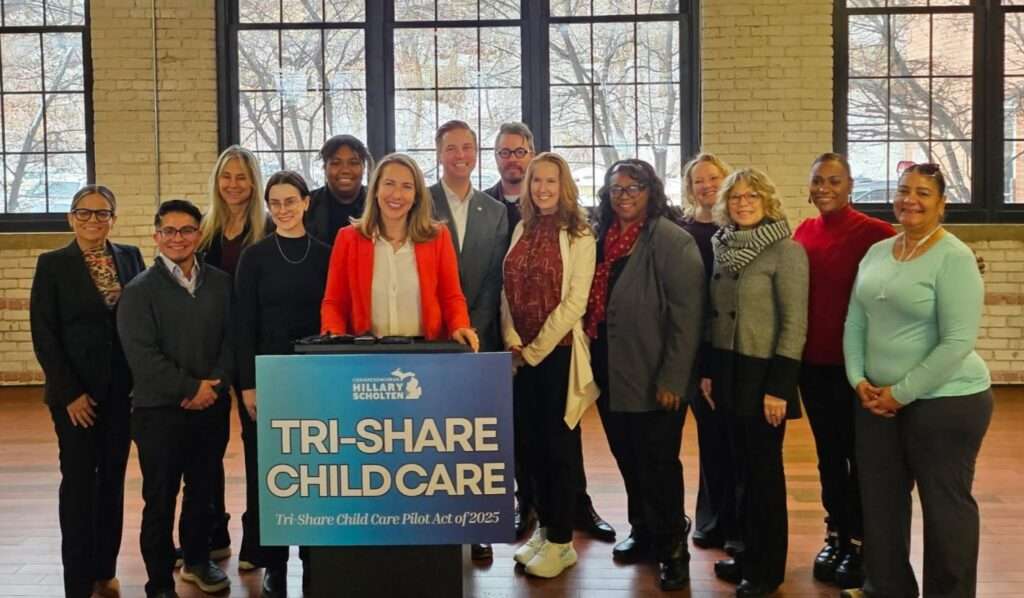
Yesterday, the Grand Rapids Chamber joined U.S. Representative Hillary Scholten to announce bipartisan legislation, supported by Representative John James, to address the rising cost of child care.
The Tri-Share Child Care Pilot Act of 2025 would create a federal program that splits the cost of child care evenly among the caregiver, the employer, and the state and federal governments.
- The bill builds on the proven success of Michigan’s Tri-Share program, which was created by the Grand Rapids Chamber, and has now been expanded into several other states.
Why It Matters:
Child care costs have more than tripled since 1990. Today, parents pay a median of $800 per month, rising to $1,100 per month for families needing 20 or more hours of care weekly.
“American families are suffocating under the crushing costs of childcare,” said Rep. Scholten. “Tri-Share offers a great opportunity to put money back in working families’ pockets, help families pursue their careers, and grow our economy.”
Rep. James emphasized the workforce and economic implications of the issue. “We cannot address Michigan’s population losses or labor shortages without tackling childcare,” he said. “Failing to fix this crisis only exacerbates the wealth gap and makes it harder for young families to build a future here.”
“Making childcare more accessible and affordable is a priority for the business community. Michigan’s Tri-Share program has become a nationally recognized innovation for supporting working families, and we’re proud that the Grand Rapids Chamber played a leading role in bringing it to life,” said Andy Johnston, Senior Vice President of Strategic Initiatives at the Grand Rapids Chamber.
“Congresswoman Scholten’s effort to federalize Tri-Share is an exciring step forward. This model shows what’s possible when business, government, and community come together, and we’re thrilled to see it advancing on the national stage,” continued Johnston.
Under the legislation, the federal government would invest $250 million annually for three years, beginning the year after enactment, to support states or municipalities that already operate—or are prepared to launch—Tri-Share programs. Federal contributions would be determined using the existing Federal Medical Assistance Percentage (FMAP) formula, ensuring need-based support across states.
Who Would Be Eligible
Families would qualify for the Tri-Share pilot if they:
- Are employed by a participating employer (with states coordinating employer enrollment)
- Earn less than 500% of the federal poverty level
- Have a child under the age of mandatory schooling
Proven Results in Michigan
The Tri-Share model has already been implemented in several states, including Michigan, North Carolina, Kentucky, Indiana, Ohio, West Virginia, Connecticut, North Dakota, and Missouri, with strong outcomes. In Michigan alone:
- 82% of participating families say Tri-Share helped them stay in the workforce
- 81% report it supports their long-term career goals
- 71% of employers say it has improved employee retention
- 80% expect it to be a critical recruitment tool
- 55% of participating employers are small or micro businesses
- 57% of child care providers report improved financial stability