
A few fewer tables each night. A shrinking lunch rush. A weekly regular who only comes in once a month now. Over the past year, working with local restaurants, we’ve seen dining rooms grow smaller, with 6–10% month-over-month declines.
Most independent restaurants fail because the margin between “open” and “closed” is paper-thin. The decline rarely arrives as a dramatic collapse but as part of a seasonal business model that keeps owners wondering how to survive our northern winters, when it feels like midnight outside by 7 p.m.
The Catering Lifeline
This is where catering becomes a lifeline. Catering is more than scaled-up takeout. It is a fundamentally different business model operating inside the same kitchen.
In any business, there are fundamentally three ways to grow revenue: attract more customers, increase how much they spend per visit, or increase how often they buy. In restaurants, that translates very directly: more people in seats, higher check averages, or more table turns.
When you look at a catering menu, every choice on that page is a negotiation between culinary creativity and logistical reality. Dishes are chosen not just because they taste good, but because they hold heat evenly in transport, can be portioned consistently, and won’t wilt into apology by the time they reach a conference room. What looks simple on paper is actually the product of timing charts, storage capacity, staffing plans, and vehicles that can move lunch across town without ruining it.
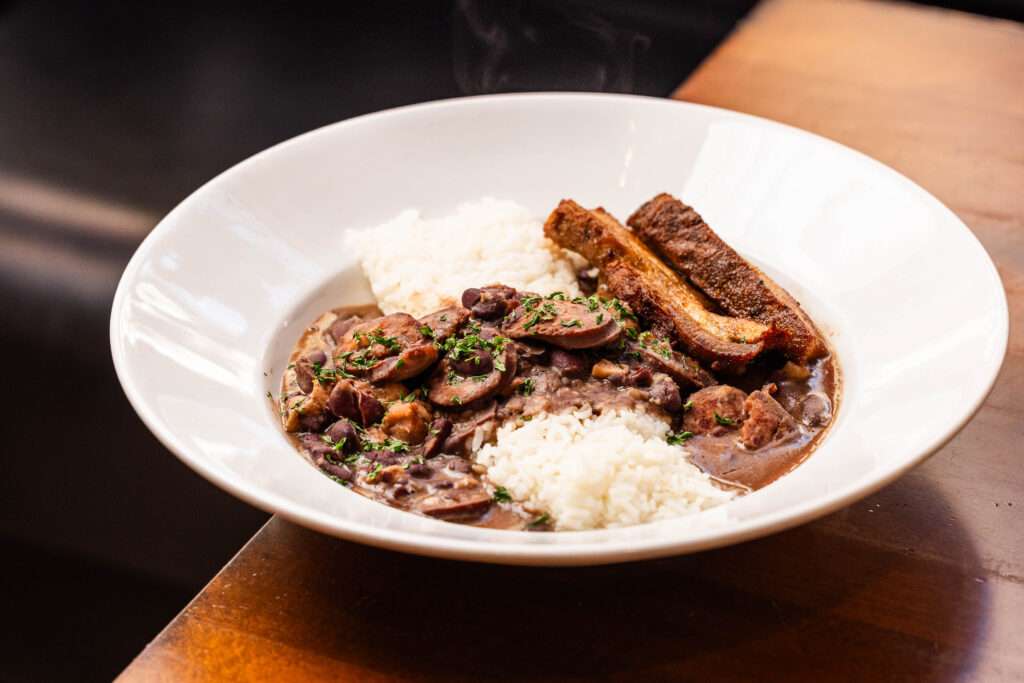
Consider a chef like Raphael Jones of Garden District in downtown Grand Rapids, crafting New Orleans-inspired dishes from scratch. In the dining room, the experience is meant to be lived in the moment: gumbo simmering slowly, shrimp po’ boys tucked into fresh bread, flavors best paired with wine and good friends.
Catering asks restaurants to take the magic of one plate made with care and deliver it to many plates at once. It becomes a second business most owners never expected to run, complete with new regulations, equipment needs, pricing models, and logistics. The complexity isn’t always obvious from the outside, and it’s exactly the kind of operational challenge the Chamber works alongside businesses to navigate.
Catering is often how restaurants break into the community. Large-format meals create connection by default. They feed offices, congregations, wedding guests, teams, and classrooms. A single successful catered event can build more loyalty than weeks of marketing, because it meets people where they are already gathered.
When you order catering from a local restaurant, you’re investing in the stabilizer that keeps that business present in your neighborhood. Local businesses give more back to local communities. A catering order is often what makes it possible for a restaurant to sponsor your child’s sports team, donate to the school auction, fund the parade downtown, and, yes, keep the lights on through a slow season.
So when the opportunity comes up, choose the restaurant down the street for your office lunch, team celebration, board retreat, or family gathering. A single order can ripple out further than you think.
And if you’re a business owner stepping into catering or trying to scale it, you don’t have to figure out that complexity alone. At the Grand Rapids Chamber, we work one-on-one with small businesses and restaurants to build sustainable catering programs, strengthen operations, and reduce the risks that come with growth. Our role is to help businesses not only open their doors, but keep them open, grow, and anchor the neighborhoods we all share for a thriving and prosperous West Michigan for all.