

Last week, the Grand Rapids City Commission passed a resolution to accept the Climate Action & Adaptation Plan (CAAP) on a 6-1 vote with Commissioner Robbins being the lone no vote.
- The Grand Rapids Chamber made comments on the potential unintended consequences of the remaining concerns (detailed below).
- Special thanks to Ken Misiewicz of Pleune Service Company for his comments based on his decades of experience in construction code, and to the many businesses who took the time to review the plan and communicate their perspective with us or city officials.
This action does not give blanket approval of the 197 actions. Implementation of specific elements will need commission approval. Staff have been directed to begin focusing on 20 prioritized items.
- In his comments, Mayor LaGrand emphasized the importance of continuing to prioritize affordable housing and not letting city actions on climate change scare off existing employers and future investors in Grand Rapids.
- We will continue to inform and engage businesses to ensure the next steps recognize market realities and are aligned with the goals of affordability, feasibility, and creating measurable outcomes.
What’s in the Resolution & Plan:
- The resolution says that the Commission accepts the plan and prioritizes 20 actions.
- We appreciate the inclusion of language clarifies intent and adds a little certainty regarding our concerns:
- That the implementation of the Climate Action and Adaptation Plan and prioritized actions shall be consistent with other goals of the City Commission, including economic prosperity and affordability, and more specifically, housing affordability, and is not intended to widen the gap of attainable and affordable housing by creating unsustainable housing and development cost increases.
- We appreciate the inclusion of language clarifies intent and adds a little certainty regarding our concerns:
- The final CAAP can be read here. The most notable change is the removal of millages as an example funding source for things such as home energy upgrades and e-bike programs.
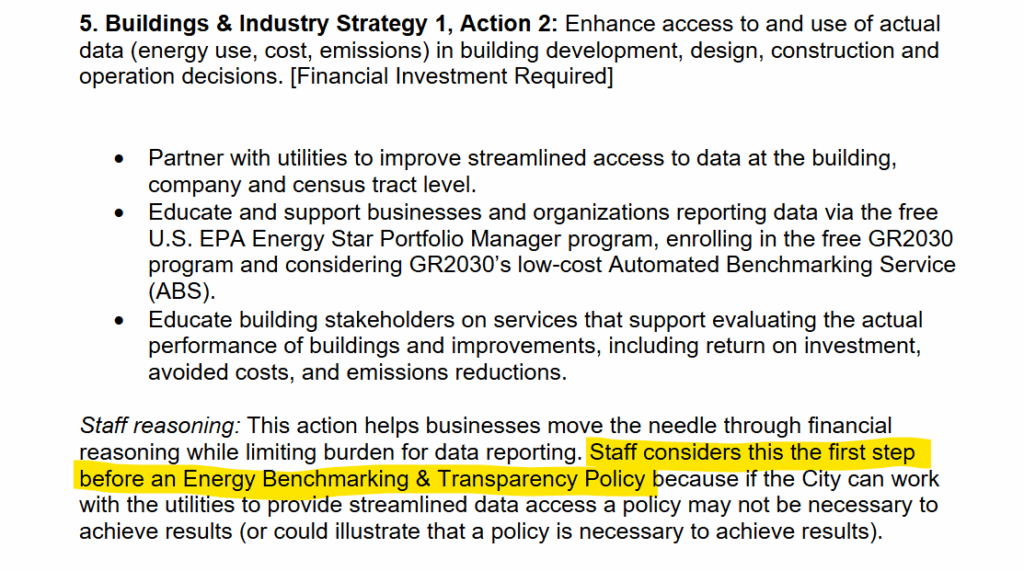
- The 20 priority actions are largely not concerning except for the inclusion of: 19. Buildings & Industry Strategy 1, Action 2 (pictured below).
- While this item does not include mandates or ‘incentive’ changes, in a June memo it was highlighted as the first step towards mandated energy reporting ordinances.
- The 20 priority actions are largely not concerning except for the inclusion of: 19. Buildings & Industry Strategy 1, Action 2 (pictured below).
other potential impacts
The following items are the remaining specific items with the highest likelihood to have unintended consequences. Our concerns are with the potential impact, not the intent. The details if/when they advance will be critical.
A number of these items run the risk of eliminating the viability of redevelopment incentives for housing and other projects, could result in future unfunded mandates, or should not be the focus of local government.
Residential Homes: Strategy 1, Actions 4, 5 & 6 (page 67) // Strategy 2, Action 3 (page 68)
- S1.Action 4: Requiring homes for sale or lease to provide an energy score or utility data adds an additional process and potential cost/uncertainty.
- S1.Action 5: The adoption of the most stringent energy code and adding additional requirements such as EV charging, energy storage, renewable energy and more will drive up costs and make housing unaffordable for more households.
- S1.Action 6: Incentivizing housing developers to exceed code will require more subsidy or higher rents/prices.
- S2.Action 3: Incentivizing housing developers to build all-electric will also require more subsidy or higher rents/prices.
Buildings & Industry: Strategy 3, Actions 1, 2 & 3 (page 78)
- Action 1: “stronger” electrical codes (as is the case is with the 21’ code) can also means tens of thousands in new costs per unit. Allowing the city to set its own codes is a major concern.
- Action 2: Incentives for energy efficiency, renewables, etc can also be a concern if they are added constraints on existing tools that are already stretched.
- Action 3: Requiring design, operations and certifications into incentives would further reduce the viability of projects as well. It must be a true add to, not a new burden.
Nature Based Solutions: Strategy 3, Action 2 (page 93)
- Increasing greenspace and open environments can have a significant impact on the buildable area of dense urban lots. Affordable housing developers have struggled with the existing rules and expansion would further decrease growth opportunities.
Food Systems: Strategy 1, Action 6 (page 100) // Strategy 2, Actions 6 & 11 (page 102 & 103)
- S1.Action 6: Government shouldn’t incentivize only certain business models and promote them as equitable.
- S2.Action 6: Prohibiting food waste from landfills could be very expensive for hospitality businesses.
- S2.Action 11: Plastic bag bans adds costs to grocers and restaurants.

Joshua Lunger
Vice President of Government Affairs
Grand Rapids Chamber