
Homelessness Is Solvable: How Grand Rapids Is Proving What’s Possible


Grand Rapids Celebrates 175 years of History



Mark Tucker joins Thrive + Prosper Leadership Team at Grand Rapids Chamber

Leveraging Economic Incentives for Your Business


Governor Whitmer Visits with Local Business Leaders





Navigating I-9 Compliance: Avoiding Common Pitfalls



Lame Duck Dysfunction
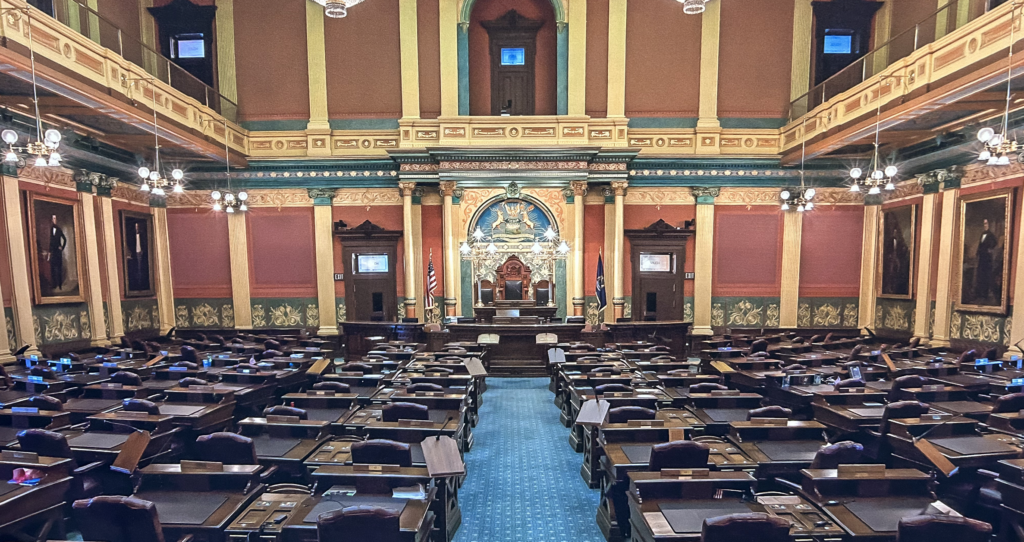
Week 3 of lame duck ended in a dumpster fire with dysfunction in Lansing. Last week’s walkout by House Republicans because of inaction on earned sick time, tipped wages and roads continued into this week keeping things at a standstill. This gridlock meant that some concerning bills died on the house floor.
- Rep. Karen Whitsett (D-Detroit) also would not reenter the House Chambers meaning a quorum could not be reached. On the final day, she stayed in Minority Leader Matt Hall’s office and a “Call of the House” was issued – meaning that all members would be required (or could be forced to) return to the House. This ultimately failed and the House adjourned without the spectacle of lawmakers dragged in by Michigan State Police.
- The Senate continued meeting, passing the 30-hour mark Friday as the Republicans (fed up with process and priorities) requested every bill be read in their entirety and made frequent comments for the record. Many bills passed on party lines and were not put through the standard committee process.
- While the failure to pass priority legislation on earned sick time and tipped wagesmakes this feel like a failure, we did see a number of dangerous pieces of legislation fail. Even the Wall Street Journal covered it.
-
A handful of Democrats in the House were pivotal in standing up to pressure and engaging with businesses in their districts about the cumulative impact of the policies being pushed. Without their courage, it is likely that the results could have been much worse for Michigan’s business climate and small employers.
The top line items follow below – from bills that would have blown generational holes in the school aid budget to legislation that would end vibrant reuse of contaminated sites, there are a number of things to be thankful for.
What’s the Plan for ESTA and Tips

Unfortunately, despite bipartisan support, changes to the Earned Sick Time Act are not happening this year.
Negotiations on a fix for roads and these items never materialized between the House, Senate and Governor. The Michigan Senate was the primary obstacle to addressing these looming threats.
Addressing ESTA and tipped wages remains the top priority for our team.
We are working with the incoming Republican House Majority and expect them to pass compromise legislation with bipartisan support in mid-January. It will then be important that the Senate understands the urgent need to make these work for small businesses.
The timeline is tight, and we know many are preparing as if ESTA will be enacted February 21. We will continue to be a resource for you and will host an implementation workshop on January 10. You can also see LEO’s FAQ document here.
- ESTA Compliance and Implementation Workshop – January 10.
Please contact Jacqui Dolce if you would like to discuss further! We appreciate how many businesses were engaged this year and hope you will subscribe to our bi-weekly newsletter if you are not already!
On to the Governor’s Desk:
- Major Increase in Unemployment Benefits (SB 40) – A significant increase in unemployment benefits passed on a near party-line vote. Benefits will be extended to 26 weeks and increased to $614/week from the current $362. Unemployment is 100% employer funded, and this creates a significant tax increase for businesses as the trust fund is spent down.
- Public Employer Healthcare Mandate (HB 6058) – Requires public employers to cover a minimum of 80% (currently the max is 80%) of employees’ healthcare benefits, raising the minimum contribution and driving up costs for local governments, schools, and other public entities.
Top Lame Duck Successes (items that had movement but fell short):
- Blocked: Worker’s Compensation Rewrite (SBs 1079 & 1080) – Proposed changes would have greatly expanded definitions of disability and claims, removed distinctions between levels of disability, applied retroactively to claims since 1985 and created significant cost increases on premiums.
- Blocked: Michigan Family Leave Optimal Coverage Act (SBs 332 & 333) – The proposed ~$1-$1.5 billion MIFLOC program would have required 15 weeks (amended to 12) of leave annually and added new complexity for small businesses. There would be a new unknown payroll tax on employers and employees to fund the program. The bill would create an extensive new bureaucratic process and create one of the most expansive programs in the country.
- Blocked: Stormwater Utilities (SB 660) – For yet another term, allowing local governments to create new stormwater utilities was washed away. This new “rain tax” would have been allowed with only a public hearing and would be assessed on property permeability. We continue to push to require a vote of the public to ensure oversight.
- Blocked: Local Wage Mandates (SB 1173) – This bill would have allowed all local governments to mandate wages, benefits, working hours and more on contractors, subcontractors and certain employers.
- Blocked: Reopening of School Pensions (HB 6060) – Allowing new employees to select defined benefit retirement options would have cost the state an estimated ~$17B over 30 years and been a disastrous burden on the school aid fund and future state budgets.
- Blocked: So-called “Polluter Pay” bills (SBs 605-607) – Would have made it infeasible to revitalize blighted properties despite existing laws that already hold polluters accountable.
- Blocked: Bottle Deposit Expansion (SBs 1112-1113) – Would have extended the 10-cent deposit to nearly all beverages and required retailers to accept any bottle for redemption, regardless of brand or origin, significantly increasing the burden on businesses without clear evidence of improving recycling rates.
- Blocked: MI Consumer Protection Act (SBs 1021 & 1022) – Would have removed an exemption that protects a business/individual performing specific licensed/regulated services. This would have opened up nearly every regulated industry and profession to lawsuits (including class action lawsuits).
- Blocked: Repeal of “Dark Stores” (HBs 5865-5868) – Would have prohibited tax assessors from using vacant stores as comparable for operating stores, driving up property taxes for retailers and other businesses.
- Blocked: Medical Malpractice Expansion (HBs 6085-6086) – Would have significantly raised the caps on non-economic damages in medical malpractice cases driving up costs for healthcare providers.
- Blocked: Limitations on Non-Compete Agreements (HB 4399) – Would have prohibited employers from requiring employees to enter into a non-compete agreement in most cases.
- Blocked: Limitations on Independent Contractors (HB 4390) – In “worst in the nation” this bill fashion would have functionally ended the ability for most businesses to use independent contractors and those who like the flexibility from doing so.
- Blocked: “Price Gouging” (HBs 5895-5897) – Would have prevented businesses from increasing the price of goods (including hotels and energy) by more than 15% during a state of emergency, without proper justification for each individual increase, creating an administrative and judicial nightmare for all businesses.
- Blocked: Prevailing Wages for Broadband Projects (HB 6051) – Would have extended prevailing wage mandates to include broadband service projects (including private projects).
- Blocked: Personal Data Privacy (SB 659) – Would have required collectors and processors of personal data to obtain additional consent and make them legally liable for breaches.
- Blocked: Restriction of Overtime for Nurses (HB 5999) – Would have prevented hospitals from requiring registered nurses from working overtime and beyond their regularly scheduled hours, with exceptions such as a state of emergency.
- Blocked: Teacher Pension (HB 6060) – Would have allowed public school employees and certain state employees to join a defined benefit pension plan as opposed to a defined contribution plan placing a long-term burden on taxpayers, reducing budget flexibility for schools, and risking underfunding the system.
*Please excuse any errors or omissions in case the Clerk wasn’t caught up or we ‘somehow’ missed something during ~30 straight hours of Senate Session
Fowl Play in Lame Duck: Some Bad Bills Take Flight, Others Stall

A chaotic week of long nights ended with some fireworks. After Republican House members walked out of session demanding to vote on amendments to paid sick leave, tipped wages and road funding. Democrats then passes a series of bills that had unanimous support from their members.
It was a rough week for business with the Michigan Senate staying late into the night/early morning to pass legislation on party lines, and the House finalized a significant unemployment increase and benefits extension to the Governor.
Fixes to keep tipped wages and improve implementation of earned sick time are both now unfortunately unable to happen this year (unless an unlikely substitute is made for earned sick time in another bill).
We did see some wins as items that failed to move from one chamber to the other are now ‘dead’ for this session. But we still have significant concerns with a number of items that now sit in the house. The House & Senate reconvene Wednesday for the final days of Lame Duck.
Top line items – what is still in play:
- The Senate passed legislation allowing local units of government to mandate employer, contractor and subcontractor wages (and other employment requirements) for any private or public project that receives an incentive (including bond financing) or has a contract with a local government. The language of the bill creates incredible uncertainty that any private employer and project receiving any incentive would be subject mandates.
-
- Joshua Lunger testified in opposition with a colleague from the Home Builders Association of Michigan with a focus on potential harm to housing development and revitalization of the metro areas of Michigan.
- So-called “Polluter Pay” bills that endanger community revitalization passed the Senate.The bills make it harder to bring blighted properties back to life, discouraging new owners from fixing them up, especially in places like Grand Rapids (SB 605-607).
-
- Michigan’s clean-up standards, which have been pivotal for community revitalization and environmental protection, are under threat. Michigan’s effective law already requires polluters to pay. It is a best practice for redevelopment efforts particularly in urban communities – where contaminated properties have been restored to vibrant use.
Top line items – what is “dead” in Lame Duck:
- The Michigan Senate failed to advance major changes to workers’ compensation that may have increased premiums ~20 to 40 percent.
- The Michigan Senate also failed to advance the “Michigan Family Leave Optimal Coverage” Act with replacement language. This new program came with massive uncertainties in costs to employers and employees and would have been one of the most expansive in the country (SB 332-333).
- Bills that would virtually eliminate independent contracting in Michigan failed to move in the House (HB 4390).
- A significant expansion to Michigan’s Bottle Deposit Law to other liquids also failed to pass the Senate (SB 1112-1113).
What else moved this week (still alive):
- “Price Gouging” bills were voted out of both the Senate and are the House.
-
- The price gouging legislation is extremely broad and would limit price increases to during a state of emergency for building materials, food, goods, lodging and more (defined as unjustified disparity in price or >10% increase). The House version was amended to 15%.
- The Senate passed a bill that would require collectors and processors of personal data to obtain consent from a consumer before processing the consumer’s personal data and provide a privacy notice concerning the purpose of that data processing (SB 659).
- The Senate passed productivity credits. This legislation helps individuals gain valuable skills and provides opportunities for life outside of prison, which reduces recidivism rates and keeps our communities safer. The bills passed the Senate yesterday. (SB 861-864)
- A bill that requires public employers to pay at least 80% of an employee’s healthcare benefits passed the Senate (SB 1129-1130) and House (HB 6058)
-
- The current maximum of 80% would now be the floor and local governments, schools and more will see their costs increase.
- A bill that would require prevailing wages for broadband projects (including private projects) stalled in the House (HB 6051).
- Bills passed the House that would eliminate mandatory overtime for nurses except in specific circumstances (HB 4551). Hospitals and Medicaid will see potentially significant cost increases to comply or be fined.
What is now “dead” because they failed to pass the first legislative chamber:
- We opposed the repeal of “Dark stores” legislation that could significantly increase property taxes on retailers. House Bill 5865-5868 would prohibit tax assessors from using vacant stores with deed restrictions as comparable real estate for open and operating stores. This hurt retailers and other businesses across the region as they try to balance tight margins, rising prices, decreasing consumer spending, and ever-increasing property tax evaluations.
- Medical malpractice legislation that could increase the cost of health care by expanding the circumstances and increasing the limits on damages for noneconomic loss. (House Bills 6085-6086; Senate Bills 1158-1159)
- Bills that would amend Michigan zoning including setting a max cap on mandated parking spaces per unit failed to move from the House after Republicans walked out to demand action on other items.
-
- These caps can be used to make residential development financially unfeasible, and we support allowing the market to respond more to demand. These were expected to pass with bipartisan support.
- A bill failed to pass the House that will raise solid waste tip fees, raising the cost of disposal in the state (HB 5333). It was put up for a vote late and Rep. Shannon (D) voted no at first, before switching. Rep. Whitsett (D) at that time had left the House floor.
- A bill requiring new nurse-to-patient ratios at hospitals was moved forward with the elimination of mandatory overtime but was never taken up for a final vote (HB 4552).
Stay in the loop
Subscribe to our government affairs communications here and text GOVERNMENT to 616-280-4617 for breaking news alerts.
Chamber membership benefit: direct help with legislator connections
As always, please contact our team with your questions and concerns. We are happy to connect you with your legislator or to further expand on any legislative topic.
Do You Have Reliable Transportation to Get to Work? Check ✅

Think back to your first job. You’re filling out an application, and it asks, “Do you have reliable transportation?” For some, the answer to this question is more complicated than others. As an employer, a “no” is a red flag for absences or tardiness. FOX 17 News Station honed in on teen transportation issues and their ability to get to work as a part of their more extensive initiative, “A Path Forward.”
Together, FOX 17 worked with The Rapid and The Village 99 to complete an initiative to give teens with difficulty getting to work a free one-month bus pass.
They called it “A Rapid Path Forward.”
The campaign distributed 108 bus passes across 5 organizations supporting their youth workforce. By removing transportation barriers, these teens can earn wages and contribute to the economy, significantly impacting their personal growth and community engagement. This initiative is a testament to the positive impact we can have on our community when we work together.
The Rapid was excited to be a part of this initiative because it exposed young people to the bussing system.
“Our public transportation system is infrastructure the six cities have invested in for years. Partnering with FOX 17 and Village 99 is a proud moment for us to help solve an access problem,” said Cassi Cooper, Engagement and Digital Specialist for The Rapid. “[The Rapid] is an access company, whether it’s access to education, employment, healthcare, or the arts and cultural events our cities have to offer. Many community partners are working behind the scenes to support mobility within our region, and the results have been overwhelmingly positive.“
The success of the initiative has prompted the Path Forward Advisory Committee to consider expanding the program. This potential expansion could offer bus passes to youth workers who would benefit from them after the school year begins, providing hope for further positive change.
Hear how access to transportation impacted one teen’s ability to get to work in this FOX 17 story
Subscribe to our newsletter to stay up-to-date on member spotlights and members in the news here.
Area Middle Schoolers Compete in First National Civics Bee® Hosted by Grand Rapids Chamber

The Grand Rapids Chamber proudly announces JaeEun Yun from Byron Center Christian School as the winner of the first 2024 National Civics Bee® hosted in West Michigan. This initiative aims to encourage more young Americans to engage in civics and contribute to their communities. The top three finalists received trophies and a ticket to the State Civics Bee:
The Winners:
1st Place: JaeEun Yun, Byron Center Christian School, $500 prize
2nd Place: Micah Sitte, Jenison Junior High, $250 prize
3rd Place: Jude Westra, East Grand Rapids Middle School, $150 prize
All participants went home with an iPad and certificate.
“It was really interesting to study and I learned a lot of new stuff,” said Yun. “It was a really great experience for me, and I think it’s good for students to participate in this.” Yun focused on education solutions and funding for private schools in his essay and discussion in the final round of the competition.
“You could tell they studied and worked really hard to identify an issue in their community, how it was connected to government, and what they could do to be a part of the solution,” said Grand Rapids Mayor Rosalynn Bliss. “I think they’re all potential future leaders.”
Organized in partnership with The Civic Trust® of the U.S. Chamber of Commerce Foundation, the competition in Grand Rapids inspired middle schoolers to become better informed about American democracy, to engage respectfully and constructively in the community, and to build greater trust in others and institutions.
“Advancing civic engagement and leadership is one way we can create a more prosperous West Michigan,” said Senior VP of Advocacy and Strategic Engagement Andy Johnston. “It was inspiring to see middle schoolers demonstrate their civics knowledge and ideas to create stronger communities.”
The Process:
Middle school students from the region were invited to submit a 500-word civics essay. The top writers went on to compete in the live quiz portion of the event to test their civics knowledge, which was judged by Grand Rapids Chamber CEO and President Rick Baker, Grand Rapids Mayor Rosalynn Bliss, and the Director of the GVSU Hauenstein Center Megan Rydecki.
Participating schools included:
- Byron Center Christian School
- Cross Creek Charter Academy
- Dutton Christian School
- East Grand Rapids Middle School
- Jenison Junior High
- Riley Street Middle School
- Rockford Middle School
- Trinitas Classical School